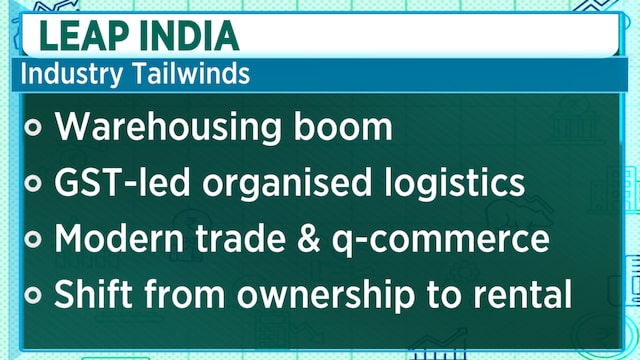
He believes this large untapped opportunity, along with the company’s nationwide asset-pooling network, positions LEAP India for long-term growth as more businesses shift from owning logistics assets to renting them.
Mathew said LEAP India operates an asset-pooling business rather than a logistics company. Instead of transporting goods or running warehouses, it rents out pallets, foldable containers, crates and forklifts that move products through the supply chain.
The company serves 38 industries and earns recurring rental income as the same asset is used by different customers at different stages of the supply chain.
Explaining the business model, Mathew said, “We absolutely do not sell anything. We tell customers, please work on Opex. You focus on your core business and don’t spend Capex.” The idea is simple: companies avoid buying expensive logistics assets while LEAP manages the assets and keeps them moving across locations.
According to the company, the biggest competitive advantage is not the pallet itself but the network built around it. LEAP has created a network of more than 10,000 locations across India, allowing customers to use a pallet in one city and return it in another without incurring the cost of transporting it back.

“The moat is our network… You can take this pallet from Baddi, you can leave it in Chennai. From there, you can take it to Siliguri… Everywhere, we collect it and give it back,” Mathew said. He added that without such a network, reverse logistics costs would make the business uneconomical.
The company also tracks every pallet digitally. If an asset goes missing, customers compensate LEAP through what it calls a “missing pallet charge”, helping protect its large asset base.
On the financial side, LEAP said it has remained earnings before interest, taxes, depreciation and amortisation (EBITDA) profitable for the last 10 years and profit after tax (PAT) profitable for the past six years. EBITDA margins have ranged between 47% and 56% over the past eight years. However, profits after tax are relatively lower because the company owns assets worth around ₹1,650 crore, resulting in annual depreciation of nearly ₹200 crore.
Chief Financial Officer Rajesham Alle said the company has focused on steadily improving its financial performance. He noted that revenue grew 55%, while profit after tax increased 66%, from ₹36 crore to ₹62 crore, highlighting the operating leverage in the business.
Management also addressed concerns over higher operating expenses in 2025-26 (FY26). The increase was largely due to LEAP’s acquisition of CHEP India’s operations, which added roughly ₹180-200 crore in revenue along with the associated operating costs. Despite the acquisition, the company said EBITDA margins have remained around 50%.
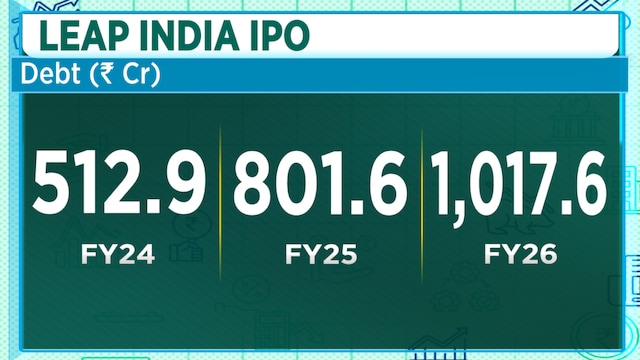
Responding to questions on valuation ahead of its IPO, Alle said LEAP is difficult to compare with other listed companies because there are very few similar businesses globally. Management pointed out that the company is the only listed player of its kind in India, while Australia’s Brambles remains one of the few listed global peers.
Watch the full conversation here

Looking ahead, the company stopped short of giving formal earnings guidance but said it remains optimistic about growth. Mathew said, “You can always say that a 35% to 40% growth in EBITDA is always on the card,” while cautioning that higher timber and plastic prices driven by geopolitical developments could temporarily affect profitability. He added that as depreciation declines over time, profit after tax is expected to grow faster than EBITDA.
Catch all the latest updates from the stock market here